
Market Commentary
The S&P 500 advanced 2.25% during the quarter, while the Nasdaq rose 3.15%, outperforming more economically sensitive segments of the market. Large technology companies and semiconductors remained important drivers of returns. As was exemplified this quarter, strong performance of indexes does not always mean the entire market is healthy. Fundamental analysis and company selection remain as important as ever. This quote from Dr. David Kelly, Chief Global Strategist at JP Morgan Asset Management, sums it up perfectly:
“As investors enter the final quarter of 2026, markets are balancing a unique mix of risks and opportunities”.
Below is a chart that shows how the S&P 500 and NASDAQ performed during Q3:
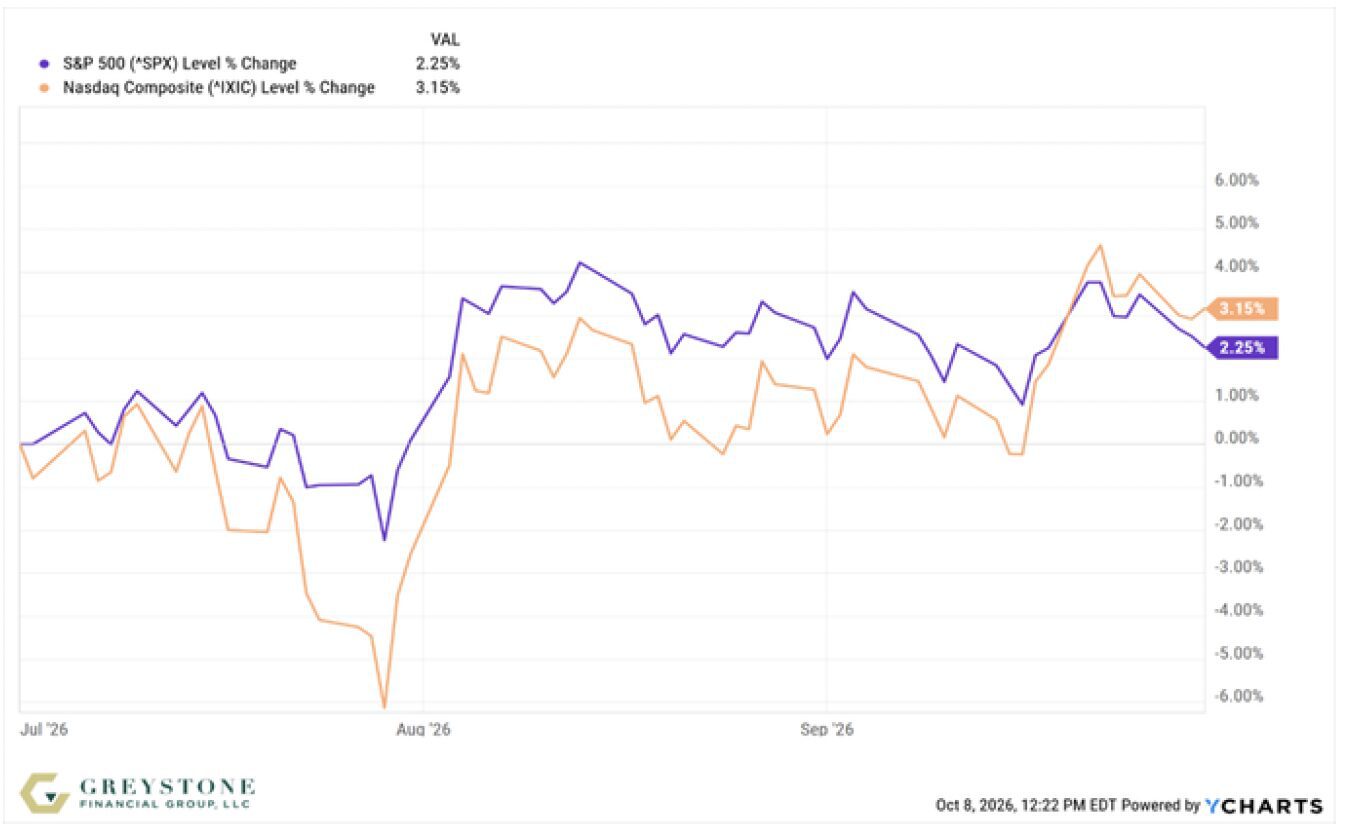
As you can see, after experiencing a sell-off in late summer and early fall, both indexes have staged a strong recovery in recent weeks. AI-related investment continues to be a dominant driver of market performance, although this growing influence also introduces a heightened risk of market concentration. The chart below highlights the extent of concentration within the S&P 500, underscoring the growing influence of a relatively small number of companies on overall index performance.
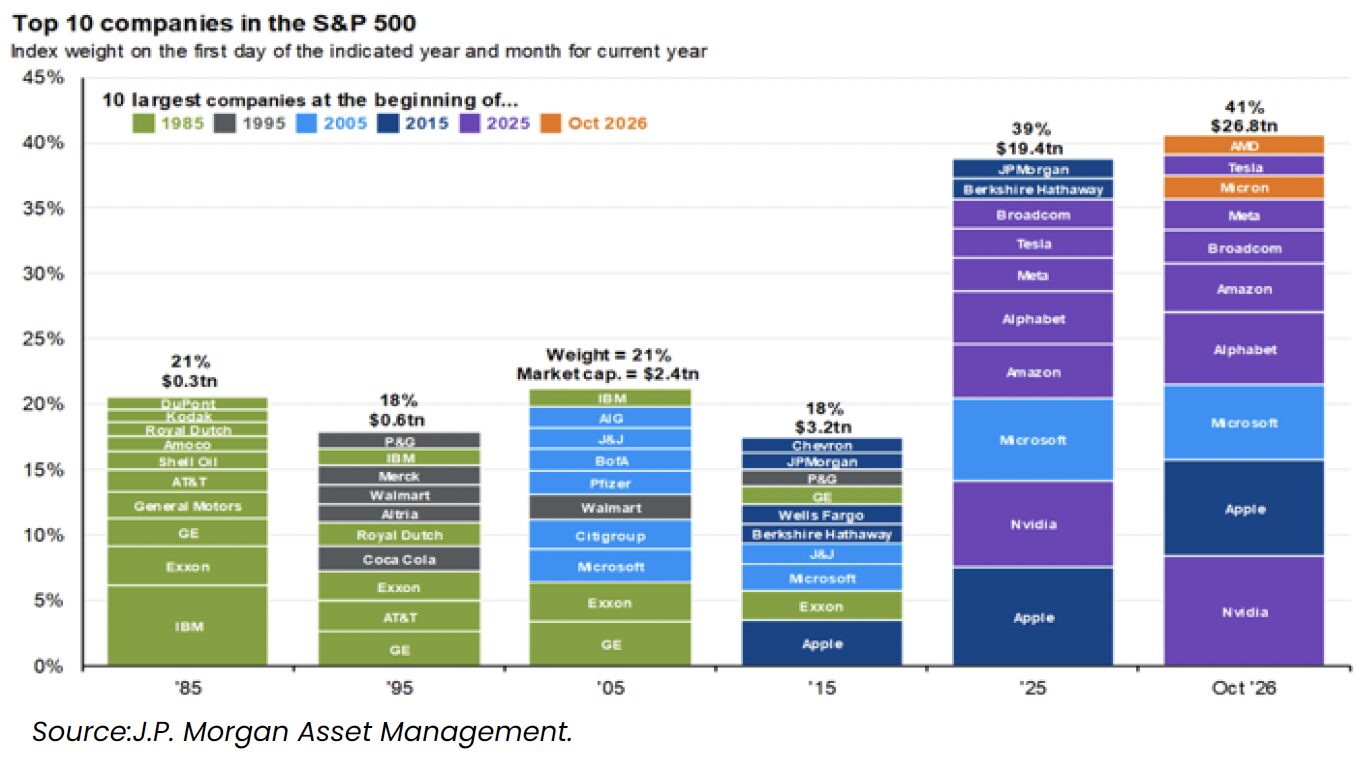
As you can see, the top 10 companies in the S&P account for 41% of the index’s weight. This represents a substantial increase from 2015, when the top 10 companies accounted for just 18% of the index’s total market capitalization. Increasingly, investors are evaluating whether significant AI infrastructure spending will translate into sustainable revenue, productivity improvements, and profitability. This highlights the importance of maintaining meaningful exposure across diverse market segments to help mitigate concentration risk. The chart also illustrates the shifting dynamics of market leadership over time, with only two companies, Microsoft and Apple, remaining among the S&P 500’s top 10 constituents since 2015.
The following charts provide a breakdown of sector performance during the third quarter, alongside year-to-date returns, highlighting the relative strength and weakness across the market.
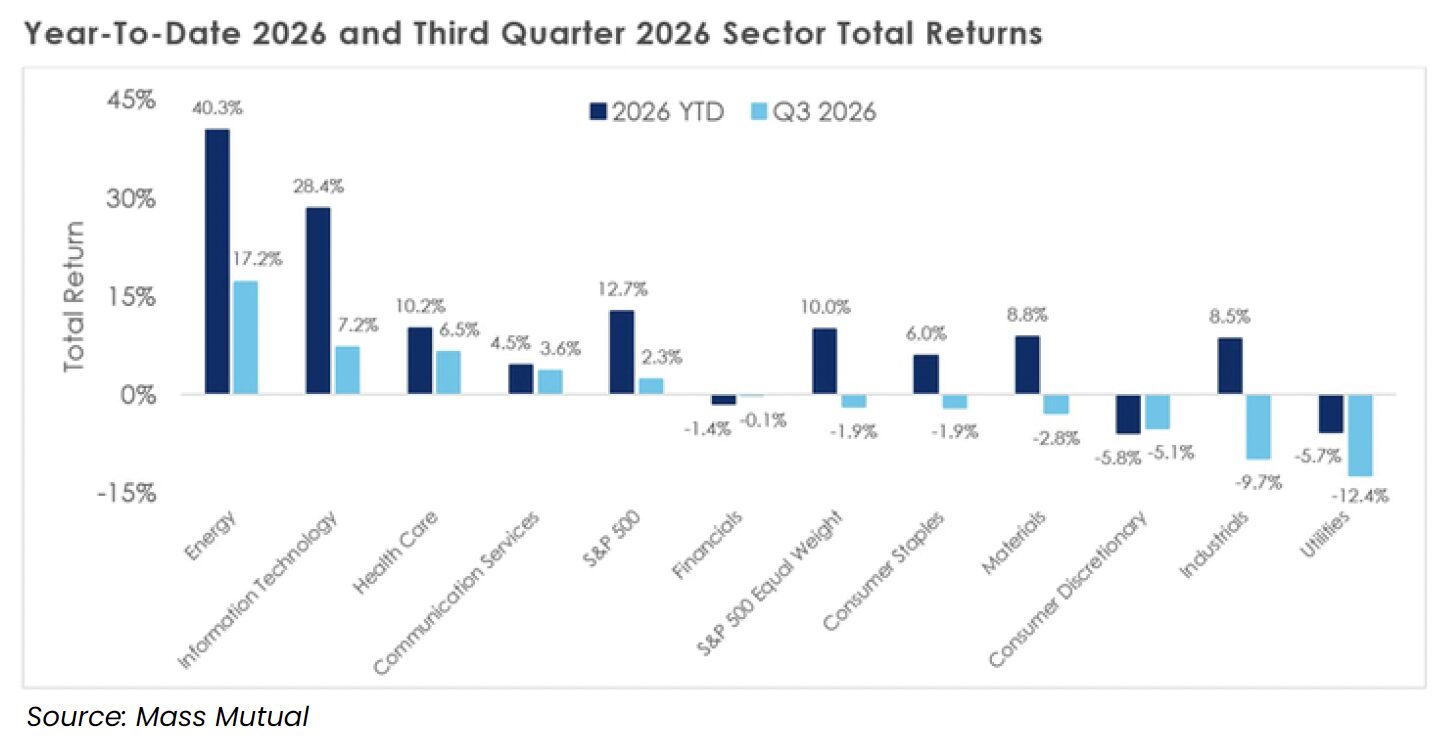
As illustrated above, energy and technology have been among the strongest-performing sectors, while consumer discretionary, industrials, and utilities have lagged behind. This divergence in sector performance reinforces the importance of disciplined, individual security selection in today’s market environment.
Economic Data and the Federal Reserve
The economic landscape continued to evolve during the third quarter, with inflation and monetary policy once again becoming central considerations for investors. In September, the Federal Reserve increased its benchmark interest rate by 25 basis points to a range of 3.75%– 4.00%, signaling that inflationary pressures remain an important concern despite continued economic growth.
Higher energy prices, geopolitical uncertainty, and resilient consumer activity have complicated the inflation outlook. Meanwhile, the labor market has shown signs of moderation without a significant deterioration in overall employment conditions.
The direction of interest rates will remain a critical driver of market performance as investors assess the potential effects of tighter monetary policy on corporate earnings, borrowing costs, and economic growth.
Geopolitical tensions in the Middle East remained a significant source of uncertainty throughout the third quarter, particularly as disruptions to our shipping channels through the Strait of Hormuz continued to influence global energy markets. The Strait of Hormuz has historically accounted for approximately 20% of global petroleum consumption, making disruptions to this passage particularly consequential for global supply and pricing.
Elevated crude oil prices present an additional challenge for the broader economy, potentially increasing transportation and manufacturing costs while placing additional pressure on consumers. WTI crude oil futures were $89.95 per barrel at the end of Q3 while reaching a high of $102.48 on 9/11/26 leading to gas prices in the $4–$6 per gallon range in the U.S.
Sustained energy price increases could also complicate the Federal Reserve’s efforts to contain inflation, potentially keeping interest rates elevated for longer than investors previously anticipated.
Looking ahead, we believe developments in the Middle East will remain an important factor to monitor and one that hopefully moves towards a resolution during Q4. While a stabilization of energy supplies could provide relief to consumers and businesses, prolonged disruptions could contribute to additional market volatility and renewed inflationary pressures.
As we enter the fourth quarter, the November midterm elections represent another key factor for investors to consider. With control of both chambers of Congress at stake, market participants will be closely watching the potential implications for fiscal policy, taxation, government spending and the regulatory landscape.
Historically, we have seen more volatility around elections; however, longer-term investment performance has generally been driven by economic fundamentals, earnings, and monetary policy rather than election outcomes alone.
Corporate Earnings: Technology Continues to Lead
Despite ongoing geopolitical tensions, elevated interest rates and persistent inflationary pressures, corporate earnings have remained a key pillar of market resilience, with technology companies continuing to drive much of the market’s strength. As we enter third-quarter earnings season, analysts are projecting approximately 30% year-over-year earnings growth for the S&P 500 with much of that growth concentrated among large-cap technology and businesses related to AI infrastructure. Here is a chart showing the estimated versus actual growth in S&P 500 company earnings:
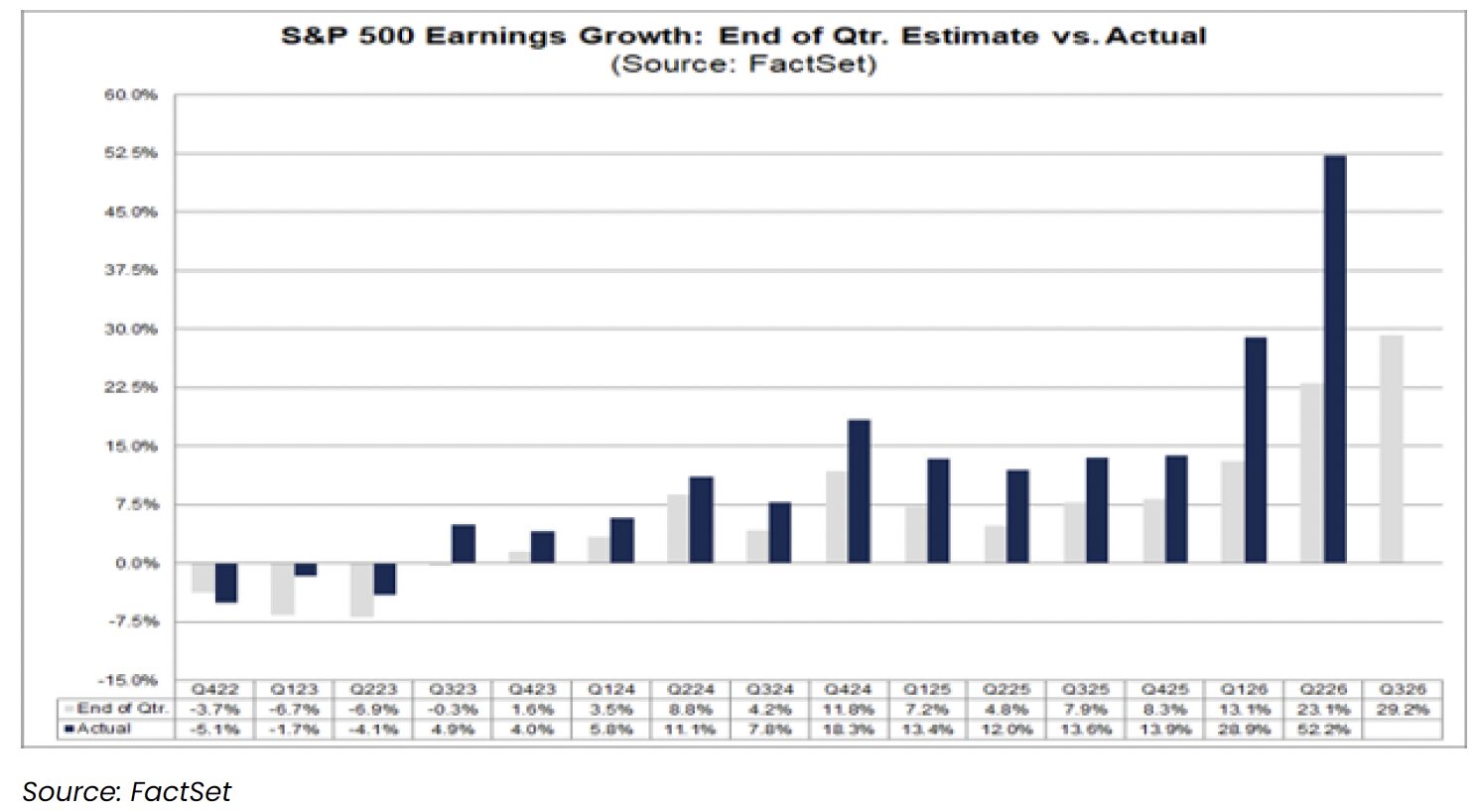
As illustrated, corporate earnings have consistently exceeded expectations over the past several quarters with actual results surpassing an already rising consensus forecast.
Continued investments in artificial intelligence, cloud computing, and semiconductors have supported strong profitability and investor optimism. At the same time elevated valuations and increasingly ambitious earnings expectations increase the market’s sensitivity to earnings disappointments. Looking ahead we believe sustained earnings growth and broader participation beyond the technology sector will be important in supporting a more balanced and durable market advance.
Looking Ahead to the Fourth Quarter
As 2026 draws to a close, investors face a dynamic economic and geopolitical backdrop with energy markets, Federal Reserve policy, and November’s midterm elections among the factors that may influence near-term volatility. At the same time the economy has remained resilient, and the stock market recently reached all-time highs providing reasons for optimism as we look toward the fourth quarter and beyond. While elevated valuations, particularly among AI- and technology-related companies, warrant careful attention, we continue to see attractive long-term opportunities. We remain focused on identifying quality investments while maintaining a disciplined and diversified approach. If you have questions or would like to discuss how these developments may affect your portfolio, please contact our team.
PLEASE SPEAK WITH YOUR WEALTH ADVISOR IF YOU HAVE ANY QUESTIONS OR WANT TO REVIEW YOUR PORTFOLIO TO BE SURE THAT YOU ARE IN THE MOST APPROPRIATE STRATEGY TO HELP YOU ACCOMPLISH YOUR LONG-TERM GOALS.

SINCERELY,
THE INVESTMENT TEAM AT
GREYSTONE FINANCIAL GROUP
DISCLOSURES
There is no guarantee investment strategies will be successful. Investing involves risks including possible loss of principal. There is always the risk that an investor may lose money. A long-term investment approach cannot guarantee a profit.
All expressions of opinion are subject to change. This article is distributed for educational purposes, and it is not to be construed as an offer, solicitation, recommendation, or endorsement of any particular security, products, or services. Investors should talk to their Wealth Advisor prior to making any investment decision.