
A volatile first quarter saw the S&P 500 decline approximately 4%, with geopolitical tensions, including the recent escalation involving the United States and Iran, and energy price movements contributing to a sharp selloff in March. Despite the pullback, earnings growth expectations remain in the low double-digit range, indicating that underlying corporate fundamentals have, thus far, remained relatively resilient compared to recent market performance.
Recent market returns have been concentrated in a smaller group of large-cap companies, though there are early signs that earnings contributions may gradually broaden. Improvements in productivity and margin trends, partly associated with ongoing advancements in artificial intelligence, continue to be an area of focus for investors as they assess the evolving earnings landscape. Below is a summary of how major indices performed during the quarter:

Despite the March volatility, the broader macroeconomic backdrop appears relatively stable. Economic growth has remained steady, inflation trends have shown signs of moderation, and market participants continue to monitor the potential for changes in Federal Reserve policy. Additionally, policy initiatives aimed at supporting domestic investment and innovation may play a role in shaping the economic environment over time.
U.S. equities have continued to demonstrate relatively stronger earnings growth compared to many international markets. While valuation differences remain a consideration, the U.S. market’s exposure to innovation-driven sectors and generally strong corporate balance sheets have contributed to its relative performance. At the same time, international markets may present opportunities depending on evolving economic and currency dynamics.
Technology remains a central area of market interest, particularly as artificial intelligence continues to develop. While the pace of innovation has drawn comparisons to prior technological shifts, the broader economic impact is still unfolding and will likely take shape over an extended period across multiple industries.
Investment opportunities are being evaluated not only within technology companies directly involved in AI development, but also across sectors that may benefit from increased efficiency, cost optimization, and new business applications tied to these advancements.
Portfolio Positioning
In the current environment, portfolio positioning continues to emphasize a balance between participation in areas of growth and maintaining diversification.
U.S. Equities: Exposure remains tilted toward U.S. equities, where earnings trends have been comparatively stronger.
Large-Cap Exposure: Allocations continue to include high-quality large-cap companies, particularly those aligned with longer-term structural trends.
Broadening Exposure: There has been a gradual increase in exposure to sectors where earnings trends appear to be stabilizing or improving, including industrials and financials.
Quality Focus: Emphasis remains on companies with strong balance sheets, consistent cash flows, and durable competitive positioning.
From a risk management perspective, portfolio exposures, position sizing, and overall concentration levels are continuously monitored to help manage potential volatility. The chart below highlights top-performing asset classes over the past decade, illustrating that U.S. large-cap equities have frequently been among the leaders over longer time periods, despite experiencing periodic drawdowns.

Economic Data & Developments
As of March 2026, the Federal Reserve has maintained the federal funds rate in a target range of approximately 3.50%–3.75%, reflecting a measured approach as inflation remains above target but has shown signs of easing, and labor market conditions remain relatively solid.
Current market expectations point toward a gradual path for monetary policy, though the timing and extent of any adjustments will depend on incoming economic data, particularly inflation readings, employment trends, and broader financial conditions. As a result, markets may continue to respond to shifts in these indicators and evolving policy expectations.
In addition to these core economic factors, recent geopolitical developments have introduced an added layer of uncertainty. On February 28, 2026, the United States, in coordination with Israel, initiated joint military operations against Iran, targeting nuclear facilities and military infrastructure. The conflict has continued through March and early April, with retaliatory actions from Iran, including missile and drone activity across parts of the Middle East.
While reports of potential negotiations have surfaced, the situation remains fluid and difficult to predict. At present, it is unclear how long tensions may persist or how conditions may evolve, though markets are closely monitoring developments.
Energy markets have been a key transmission mechanism for these events. The Strait of Hormuz, through which a significant portion of global seaborne crude oil flows, has experienced disruptions, contributing to a notable increase in oil prices from the mid-$60 range earlier in the quarter to above $100 per barrel in recent weeks. The extent and duration of these disruptions remain important variables for global markets.
Higher energy prices have implications for inflation and economic activity globally, particularly for countries with a greater reliance on imported oil. While the United States is a net energy producer, rising prices can still influence broader inflation trends and consumer spending. In response, there have been indications of potential increases in production from both domestic sources and OPEC, which could help alleviate some supply pressures over time.
From a policy standpoint, sustained increases in energy prices could complicate the Federal Reserve’s path, particularly if inflation proves more persistent. At the same time, any signs of slowing economic activity may influence how policymakers balance their dual mandate of price stability and maximum employment.
Overall, the situation continues to evolve, and markets are likely to remain sensitive to both geopolitical developments and their potential economic impacts. The federal reserve is going to meet again on 4/28-4/29 to determine if rates will be increased/decreased or remain the same.
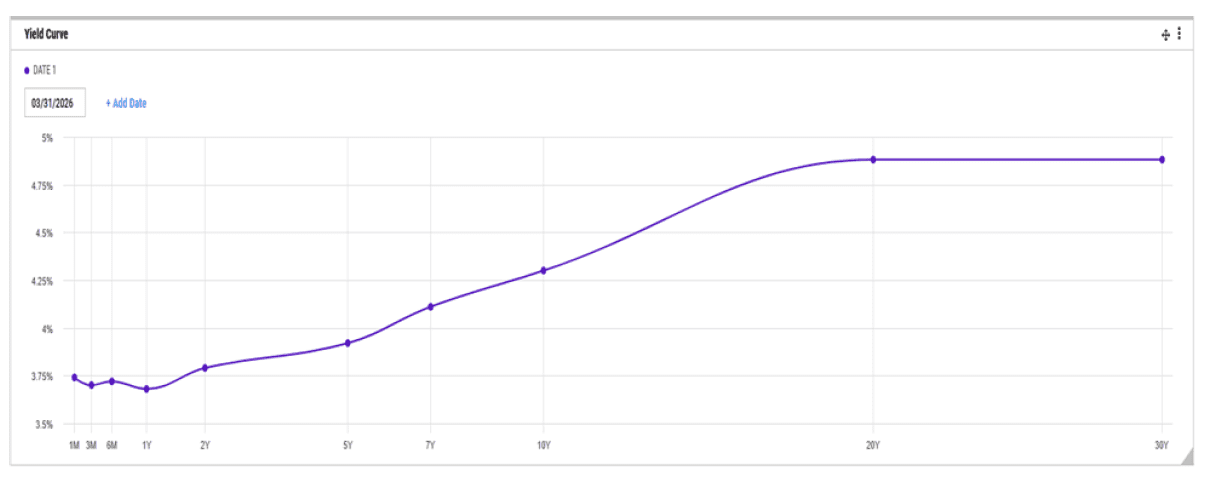
The U.S. Treasury yield curve remains either flat or modestly inverted at the moment, signaling that markets still expect slower economic growth and potential policy easing ahead. While shorter-term yields remain elevated, longer-term yields remaining relatively anchored suggesting markets believe the Federal Reserve is nearing the end of its tightening cycle, with fewer additional rate hikes expected from here. Following is a snapshot of the U.S. Treasury yield curve as of 3/31/26:
Final Notes
As the year progresses, market conditions will likely continue to be shaped by a combination of earnings trends, economic data, and geopolitical developments. Notably, President Donald Trump recently announced a ceasefire agreement between the United States and Iran, with early indications that transit through the Strait of Hormuz may resume on a provisional basis over the coming weeks (as of April 7, 2026). While these developments could help alleviate some near-term pressure in energy markets, the situation remains fluid and will depend on how conditions evolve.
A broader participation in earnings growth, alongside a more stable macroeconomic backdrop, could contribute to a more balanced market environment over time, though uncertainty remains. We will continue to monitor these developments.
PLEASE SPEAK WITH YOUR WEALTH ADVISOR IF YOU HAVE ANY QUESTIONS OR WANT TO REVIEW YOUR PORTFOLIO TO BE SURE THAT YOU ARE IN THE MOST APPROPRIATE STRATEGY TO HELP YOU ACCOMPLISH YOUR LONG-TERM GOALS.

SINCERELY,
THE INVESTMENT TEAM AT
GREYSTONE FINANCIAL GROUP
DISCLOSURES
There is no guarantee investment strategies will be successful. Investing involves risks including possible loss of principal. There is always the risk that an investor may lose money. A long-term investment approach cannot guarantee a profit.
All expressions of opinion are subject to change. This article is distributed for educational purposes, and it is not to be construed as an offer, solicitation, recommendation, or endorsement of any particular security, products, or services. Investors should talk to their Wealth Advisor prior to making any investment decision.