
U.S. equity markets delivered a strong rebound during the second quarter, demonstrating considerable resilience despite elevated geopolitical uncertainty, rising energy prices, and renewed concerns surrounding inflation and interest rates. The S&P 500 and Nasdaq were on pace to record their strongest quarterly advances in several years, reversing much of the volatility experienced during the first quarter. The chart below compares the performance of the S&P 500 and Nasdaq during the second quarter:
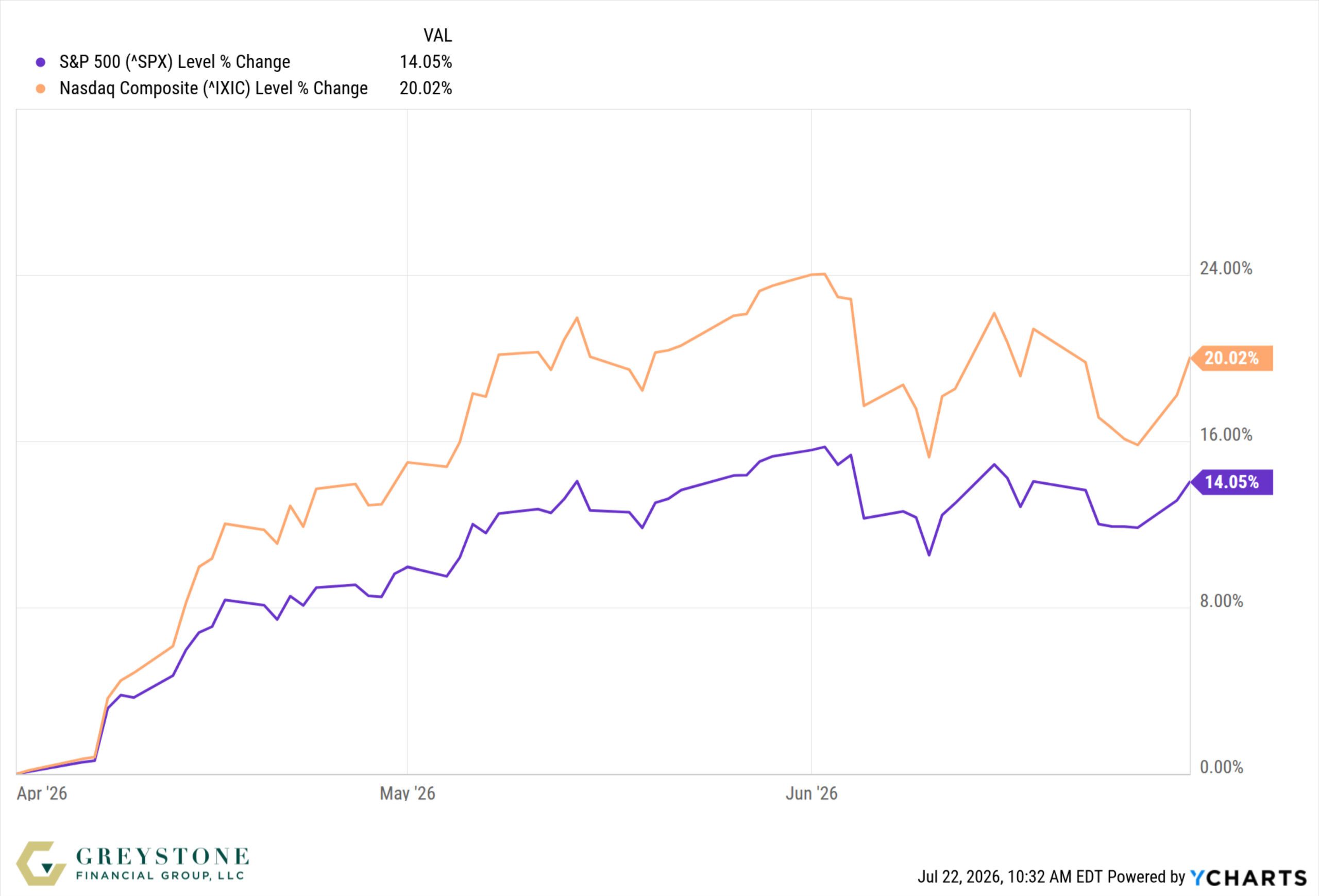
Investor optimism continues to be supported by healthy corporate earnings, resilient consumer activity, and significant capital investment associated with artificial intelligence. However, the market’s advance has not occurred in a straight line. Technology and semiconductor stocks experienced increased volatility toward the end of the quarter as investors began evaluating whether future earnings growth would be sufficient to justify elevated expectations.
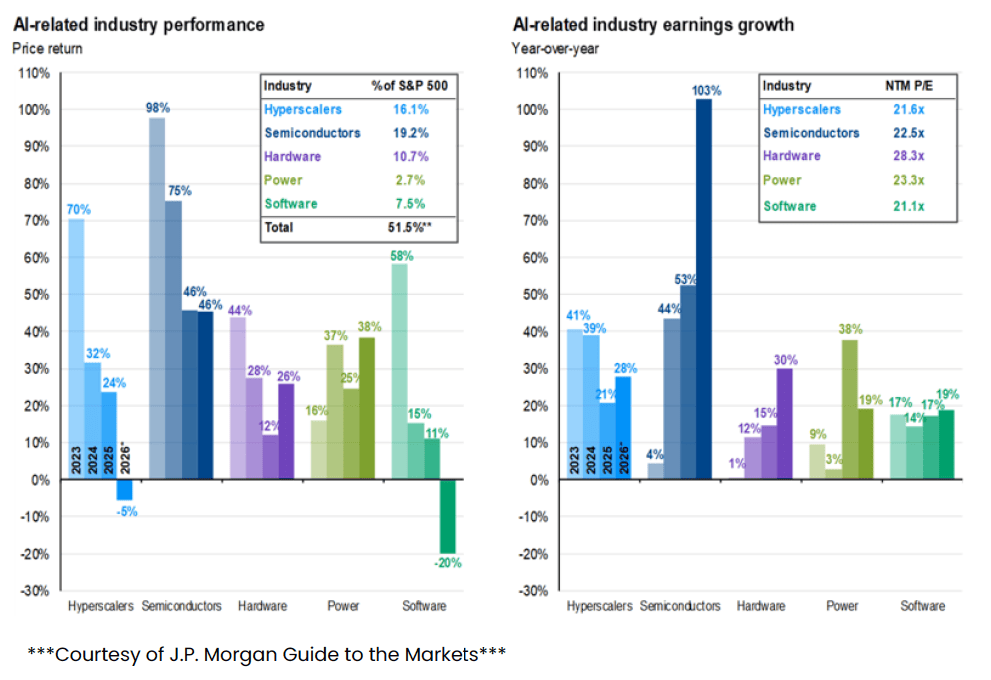
Artificial intelligence remains one of the market’s most important long-term investment themes, but the opportunity is expanding beyond traditional tech companies. The buildout of AI infrastructure is creating demand across semiconductors, data centers, electrical equipment, power generation, cooling systems, networking, and other industrial applications.
Large technology companies continue to commit substantial capital to these projects, reinforcing our view that AI represents both a technological transformation and a broader infrastructure investment cycle. The chart below highlights the growth of AI-related sectors over the past four years and illustrates how broadly the theme has supported multiple areas of the market.
While we remain bullish on the long-term outlook for equities, the market’s strong recent performance makes security selection increasingly important. Companies will need to deliver earnings growth that supports current valuations. We believe businesses with durable competitive advantages, strong balance sheets, healthy free cash flow, and identifiable long-term growth drivers remain best positioned in the current environment.
Geopolitical Developments
Over the past two months, the conflict involving Iran, Israel, and the United States has remained one of the most significant geopolitical developments in the Middle East.
Following heavy fighting earlier this year, military activity has shifted from large-scale direct combat toward a mix of limited strikes, maritime security incidents, and diplomatic negotiations. While a ceasefire framework and memorandum of understanding were announced in June, tensions remain elevated, particularly around the Strait of Hormuz, where shipping security continues to be a major concern for global energy markets.
Today, the situation can best be described as an uneasy and fragile pause rather than a lasting peace. Diplomatic efforts are ongoing, but periodic military actions and retaliatory incidents continue to highlight the risk of renewed escalation. Investors and policymakers are closely monitoring the region, as any disruption to energy supplies or shipping routes could have broader economic implications. For now, the path toward a durable resolution remains uncertain, and recent comments from President Trump suggest negotiations may face renewed challenges.
Economic Data and the Federal Reserve
The U.S. economy continues to expand at a solid pace. The labor market added 172,000 jobs in May, while the unemployment rate remained at 4.3%. Although hiring has moderated from the unusually strong pace experienced earlier in the economic cycle, employment conditions remain generally stable and continue to support consumer spending.
Inflation, however, has reemerged as a concern. The Consumer Price Index increased 4.2% over the 12 months ending in May, largely reflecting a significant increase in energy prices. Core inflation, which excludes food and energy, was more moderate at 2.9% but remained above the Federal Reserve’s long-term target. The chart below compares headline inflation, core inflation, producer prices, and the target federal funds rate:
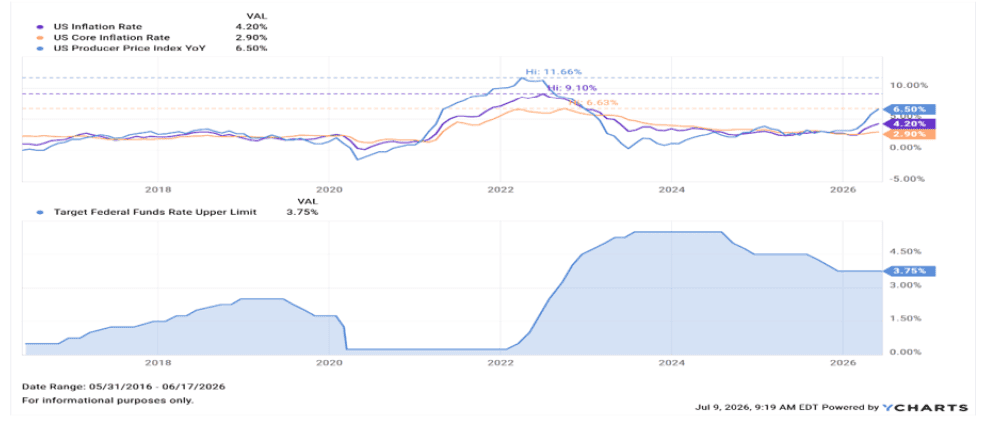
The Federal Reserve’s preferred inflation measure told a similar story. The Personal Consumption Expenditures Price Index increased 4.1% from a year earlier, while core PCE inflation was 3.4%. Consumer spending remained positive, with real spending increasing 0.3% during May, although the personal saving rate remained relatively low at 3.0%.
At its June meeting, the Federal Reserve maintained the federal funds target range at 3.50%–3.75%. Policymakers acknowledged solid economic activity, strong capital investment, and a stable labor market, but also emphasized that inflation remains a concern. This combination reduces the likelihood of aggressive near-term rate cuts and may keep interest rates higher for longer than was previously anticipated.
Portfolio Positioning
Against this backdrop, we continue to emphasize companies with strong fundamentals rather than attempting to predict short-term movements in interest rates, Federal Reserve policy, or geopolitical events.
Potential changes in Federal Reserve leadership add another important variable for investors to monitor. Early indications suggest the Fed may rely less on forward guidance and place greater emphasis on incoming economic data when setting policy. While this approach may give policymakers more flexibility, it could also lead to increased volatility in interest rates as markets adjust to fewer signals about the Fed’s future path. For investors, this reinforces the importance of remaining disciplined, diversified, and focused on long-term fundamentals rather than reacting to every short-term shift in monetary policy expectations.
Within equities, we remain focused on businesses benefiting from durable secular trends, including artificial intelligence, data-center infrastructure, electrification, automation, cybersecurity, and rising demand for power. We also continue to identify opportunities in select industrial, financial, and consumer-oriented companies where earnings growth and valuations remain attractive.
At the same time, we are mindful of the risks associated with crowded investment themes and elevated expectations. Positions are evaluated based not only on long-term growth potential but also on valuation, balance-sheet strength, earnings quality, and a company’s ability to convert growth into profit and shareholder value.
Within fixed income, higher yields continue to provide meaningful income opportunities. However, the uncertain inflation outlook and potential for changing Fed communication under new leadership reinforce the importance of managing duration and maintaining an appropriate balance between income generation and interest-rate risk.
Looking Ahead
As we enter the second half of 2026, several factors are likely to influence financial markets:
Whether corporate earnings can meet elevated expectations. The sustainability and profitability of AI-related capital spending. The path of inflation and future Federal Reserve policy.
Developments in energy markets.
Resolution, or continued escalation, of geopolitical conflicts. Potential policy and election-related volatility.
We expect periods of volatility as investors respond to these competing forces. Nevertheless, the underlying economy remains resilient, corporate investment remains healthy, and innovation continues to create attractive long-term opportunities.
Our approach remains disciplined: focus on quality, remain selective, manage risk, and use periods of market volatility to invest in businesses with strong long-term fundamentals.
PLEASE SPEAK WITH YOUR WEALTH ADVISOR IF YOU HAVE ANY QUESTIONS OR WANT TO REVIEW YOUR PORTFOLIO TO BE SURE THAT YOU ARE IN THE MOST APPROPRIATE STRATEGY TO HELP YOU ACCOMPLISH YOUR LONG-TERM GOALS.

SINCERELY,
THE INVESTMENT TEAM AT
GREYSTONE FINANCIAL GROUP
DISCLOSURES
There is no guarantee investment strategies will be successful. Investing involves risks including possible loss of principal. There is always the risk that an investor may lose money. A long-term investment approach cannot guarantee a profit.
All expressions of opinion are subject to change. This article is distributed for educational purposes, and it is not to be construed as an offer, solicitation, recommendation, or endorsement of any particular security, products, or services. Investors should talk to their Wealth Advisor prior to making any investment decision.