Every time global tensions rise, whether it’s conflicts involving major economies, regional instability, or escalating international disputes, investors are reminded just how connected world events and financial markets can feel.
Headlines become louder. News alerts become more frequent. Social media amplifies worst-case scenarios. It can feel as though the foundation of the global economy is shifting in real time.
Yet, despite this constant stream of uncertainty, the stock market has shown a long-standing pattern of resilience. It reacts in the short term, but over longer periods, it tends to reflect something very different from the headlines: earnings, economic growth, innovation, and productivity.
Understanding this distinction is one of the most important parts of staying disciplined as a long-term investor.
Markets React to News, But They Are Driven by Fundamentals
It is true that markets respond quickly to geopolitical events. Sudden conflicts, trade disruptions, or global instability often trigger immediate volatility. Prices may swing, oil may spike, and investors may rush to reassess risk. But these reactions are often driven more by emotion and uncertainty than by long-term economic damage.
Over time, markets tend to refocus on what ultimately drives value:
- Corporate earnings and profit growth
- Interest rates and inflation trends
- Employment and consumer spending
- Productivity and innovation
- Global economic expansion
Geopolitical events can influence these factors, but they rarely define them in a lasting way. Put differently, news affects sentiment, but fundamentals determine direction.
Why Geopolitical Events Feel So Impactful in the Moment
Events such as the ongoing tensions involving Iran, Israel, and the United States, or the prolonged conflict between Russia and Ukraine, are naturally emotionally charged. They involve global attention, humanitarian concern, and uncertainty about broader economic consequences.
From an investor’s perspective, the concern usually centers around questions like:
- Will energy prices spike?
- Could supply chains be disrupted?
- Will inflation reaccelerate?
- Could global growth slow?
These are valid questions. Markets do attempt to price in potential outcomes quickly, which is why volatility often increases during these periods.
However, what markets struggle with most is not bad news itself but unknown outcomes. Once uncertainty becomes clearer, markets typically stabilize even if the underlying situation remains complex.
A Historical Pattern: Markets Absorb Shocks Over Time
History provides an important perspective. Over the past several decades, markets have navigated countless geopolitical events, including wars, terrorist attacks, political crises, and international tensions. In nearly every case, markets initially reacted sharply but later recovered as economic activity continued and businesses adapted.
The key takeaway is not that geopolitical events do not matter, but rather that their long-term impact on diversified global markets has typically been less severe than feared in the moment.
Markets are forward-looking mechanisms. They attempt to price in expectations of the future, not just current events. This is why they often begin recovering well before headlines improve.
The Economy and Corporate Earnings Matter More Than Headlines
At the core of long-term market performance is a simple driver: corporate profits.
Companies across technology, healthcare, consumer goods, and industrials sectors generate earnings based on real-world demand for goods and services. These earnings are influenced by broad economic conditions such as:
- Consumer spending strength
- Business investment
- Interest rate environments
- Labor market health
- Global trade activity
While geopolitical events can temporarily influence these factors, they rarely override them entirely. For example, even during periods of global uncertainty, many companies continue to innovate, expand, and grow earnings. Technology advances, healthcare demand persists, and consumer behavior adapts.
This is why markets often look past short-term disruptions and refocus on long-term economic reality.
Volatility Is Not the Same as Risk
One of the most common investor mistakes is confusing volatility with permanent loss. Volatility refers to short-term price fluctuations. It is uncomfortable, but normal. Risk, in the long-term investment sense, is the permanent loss of capital.
Geopolitical events often increase volatility, but they do not necessarily increase long-term investment risk in diversified portfolios the same way investors fear in the moment. In fact, volatility is often the price investors pay for long-term returns.
Without periodic uncertainty, markets would not offer the growth potential they historically have.
The Role of Media Amplification
Another factor that heightens investor anxiety during geopolitical events is the way information is delivered today.
News is constant, immediate, and often framed in urgent or emotional language. Phrases like “global crisis,” “escalation,” or “breaking developments” are designed to capture attention, but they do not always reflect long-term economic outcomes.
This creates a gap between perception and reality.
Investors are exposed to a 24-hour cycle of worst-case scenarios, while markets are continuously processing data and adjusting expectations in a more measured way. This mismatch can lead to overreactions, such as selling during periods of heightened fear or stepping away from long-term strategies.
Why Staying Invested Matters Most During Uncertainty
One of the most consistent findings in investing is that timing the market is extremely difficult, even for professionals. Periods of uncertainty often cluster around some of the strongest recovery days in the market. Missing even a small number of these rebounds can significantly reduce long-term returns.
This is why maintaining exposure to the market, rather than reacting to short-term events, has historically been a more effective strategy for long-term investors. Staying invested allows portfolios to participate in recoveries, compounding growth, and long-term economic expansion, even when the path is uneven.
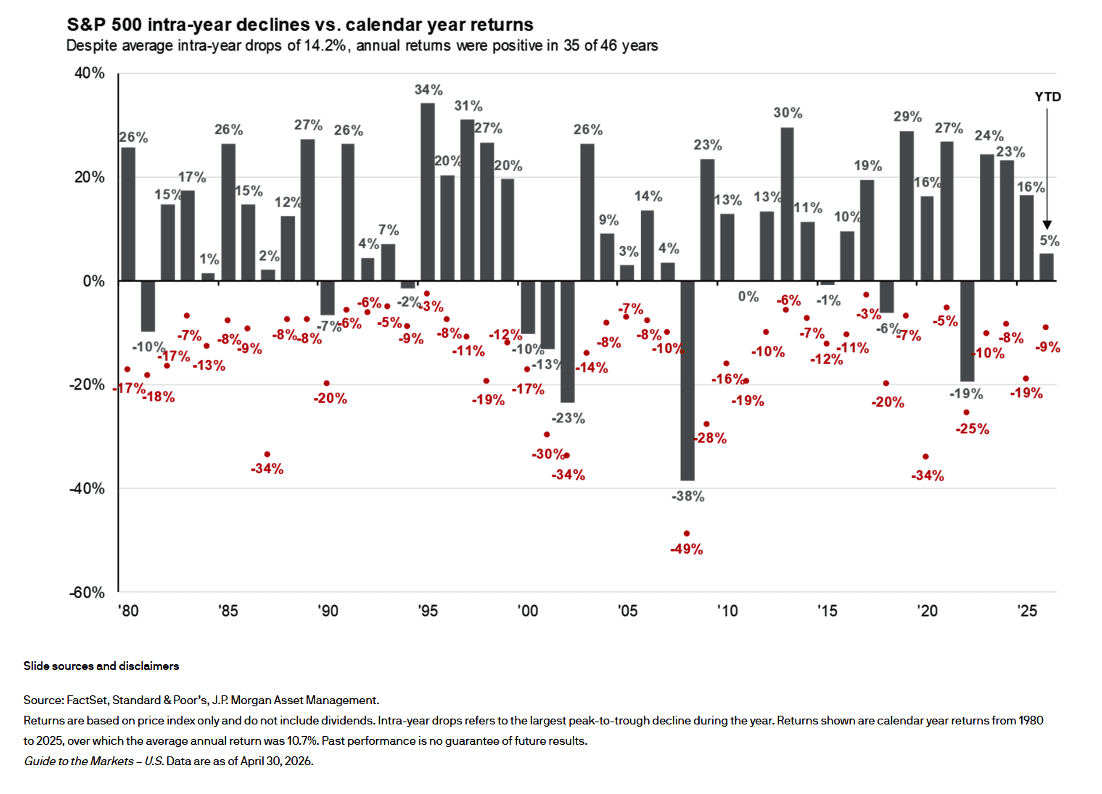
The following chart is from J.P. Morgan Asset Management’s Guide to the Markets. It highlights the relationship between intra-year market volatility and long-term annual returns.
The chart illustrates the S&P 500’s annual returns alongside each year’s largest intra-year decline since 1980. While markets have frequently experienced meaningful pullbacks during the year, the S&P 500 has historically ended most calendar years with positive returns. This serves as a reminder of the importance of maintaining a long-term investment perspective and remaining disciplined through periods of market volatility.
The Importance of a Long-Term Framework
Geopolitical events will always be part of the global landscape. They are unpredictable in timing and outcome, but they are not new to markets.
A disciplined investment approach focuses less on predicting these events and more on preparing for them through:
- Diversification across asset classes and geographies
- A portfolio aligned with time horizon and risk tolerance
- Regular rebalancing to maintain structure
- A long-term investment perspective
This framework does not eliminate uncertainty, but it helps ensure that short-term events do not derail long-term financial goals.
What Investors Should Focus on Instead
Rather than reacting to every geopolitical headline, investors are often better served by focusing on factors that have historically driven long-term returns:
- Are corporate earnings growing over time?
- Is the economy expanding or contracting?
- What is the direction of inflation and interest rates?
- Are innovation and productivity improving?
These are the forces that ultimately shape markets over years and decades—not day-to-day headlines.
Final Thoughts
Geopolitical events will continue to emerge and evolve. They may be unsettling, and at times they may create meaningful short-term market volatility. But history has consistently shown that markets are resilient systems that adapt over time. They process uncertainty, incorporate new information, and ultimately return their focus to economic and corporate fundamentals.
For long-term investors, the most important discipline is not predicting what happens next on the global stage, it is maintaining perspective when headlines feel overwhelming.
Markets are not immune to global events, but they are driven by more than that. Earnings grow, economies expand, and innovation continues, even in periods of uncertainty. Staying invested, staying diversified, and staying focused on long-term goals remains one of the most reliable approaches investors can take.
In moments when the world feels unstable, it often helps to remember that markets have seen uncertainty before, and they have continued forward. And over time, that resilience is what has powered long-term growth.

Nick Loberg
Portfolio Manager
Disclosures:
This is provided for informational purposes only and should not be interpreted in any way as investment, tax, accounting, legal or regulatory advice. An investor must take into consideration his/her individual circumstances.
There is no guarantee investment strategies will be successful. Investing involves risks including possible loss of principal. There is always the risk that an investor may lose money. A long-term investment approach cannot guarantee a profit. All expressions of opinion are subject to change. This article is distributed for educational purposes, and it is not to be construed as an offer, solicitation, recommendation, or endorsement of any particular security, products, or services. Investors should talk to their wealth advisor prior to making any investment decision.